Arts & CultureComments Off on Music Spotlight: Spanish Pianist Guillermo González
World renowned pianist, Guillermo González marks his first visit to Toronto, and Canada, at the Mooredale Concerts Series this Sunday, March 16th. Born in Tenerife, Spain, González is considered a great specialist of Spanish music, and one of the most important Spanish pianists.
Disciple of José Cubiles, Vlado Perlemuter and Jean Paul Sevilla, Gonzáles studied at the Conservatory of Santa Cruz de Tenerife, and later in Madrid’s Royal Conservatory of Music, and Paris’ Schola Cantorum and Conservatoire Superieur de Musique. In 1998 he published a new version of Albéniz’s Iberia; this edition is considered the definitive source for the performance of this work. His long career has earned him several critical praises, as well as, important awards and honours.
Since this is Señor González’s first visit to our city, I wanted to learn more about him and his work. He graciously answered a few of my questions.
HM: Given your recital at Mooredale Concerts is your first visit to Canada, could you share more about the musical influences that have led you to this point in your career.
G. González: During the time I studied at the National Conservatory in Paris, with maestro Vlado Perlemuter, I interacted with several Canadian students, including the wonderful pianist Claude Savard. He won first place at one of the musical contests in Munich, actually. My formative years were spent in a Francophone environment and I was lucky to assimilate within the impressionist musical artistry thanks to my mentors, Vlado Perlemuter, who studied under Marcel Ciampi — who was very well versed with Maurice Ravel. During this time, I also learned from Jean Paul Sevilla, a mentor, who through Ciampi learned Debussy’s creations first hand. In fact, Sevilla was a piano professor in Ottawa for about twenty years. I suppose you could say I learned within a Hispanic-French environment.
HM: The Pengyou project, which aimed to teach and share Spanish music at the Shanghai Conservatory and China’s Central Conservatory (Beijing) sounds rather amibitious. In your own words, how would you describe its success thus far?
GG: The Pengyou Project began with very high hopes, and its success has even surprised me. I am invited quite frequently to offer ‘master classes’ at the Conservatories, as a master pianist and as an international professor. As such, I feel very humbled they asked me to participate at the concert celebrating the 2008 Olympic games in China, during which I shared the stage with Lang Lang, Philippe Entremont, Liyun Di, among others.
I believe the Chinese public is very welcoming of other cultures. The success Spanish music has in China is in part due to this country’s need to learn to appreciate different types of music. Traditionally, Spanish music has not reached as wide appeal as it deserves. In China, our music has reached a certain notable impact and appeal. From another perspective, piano studies have become widely popular in the last few years. In this context, a pianist who learns to play Spanish music acquires a specialization that make their programmes and classes even more attractive. Spanish music is not only high class but it outstanding for a pianist to master; this is what makes it so outstanding and valuable in China at the moment.
HM: Your publication of Albéniz’s Iberia has been called its most definitive. For those of us who are new to Albéniz and his work, what makes this piece so important to you? And how should we, as a new audience (so to speak), approach this piece?
GG: Albéniz’s Iberia is important not only for me, personally. Debussy was actually obsessed with El Albaicín and Eritaña. Olivier Messaien even said, “Iberia is a marvellous piece for piano, and it perhaps holds the highest place in terms of pieces for such a regal instrument.” Because of this, it has become a staple in the repertoire of greats like Claudio Arrau and Arthur Rubinstein. Thus, creating an even bigger interest for pianist virtuosos like Marc André Hamelin, Lang Lang and Daniel Barenboim. Currently, there are over 50 recordings of Iberia worldwide; it’s of high interest for international pianists.
For me, Iberia is a fountain of pleasure. I listen to it every morning and night, and always find something new that speaks to me. I never tire of going through its music sheets; something that can only happen with a great composer’s work. Iberia is written rather admirably; its synthesis contains a myriad of elements… we find the traditional language of Andalusian music, forms found in popular Spanish music — starting with Renaissance polyphony– the tradition of the Spanish
Vihuelistas, the organ music from the XVIII century (influenced by Domenico Scarlatti), the Romantic Spanish piano, and several influences from the then new-born Flamenco…
If you listen to this piece of music for the first time, you have to understand that this is not Flamenco. In Iberia, you can find many elements that later became part of Flamenco, but these elements are not the essence of this type of music. In some respects, Albéniz’s approach is quite similar to Béla Bartok’s; except that Bartok often uses popular materials from a literal point of view. Albéniz doesn’t do that… What it’s incidental shouldn’t influence the spiritual message, which [in Iberia] ranges from melancholy to drama. These two essential characteristics united with rhythm, and emphasized by a deep expressiveness, are almost painful to experience.You may frequently believe that Spanish music is cheerful in its nature… far from the truth. Spanish cante has drama and it’s deeply sad. You can never forget that Iberia was composed by a dying and exiled man. Happiness is contemplated with homesickness, which adds a veiled pain.
HM: Your many accomplishments aside, what else are you looking forward to in your career? And what else can we look forward to in terms of recordings, or perhaps a return visit to Toronto?
GG: In my career, I always look forward to keep doing what I do and share it with the public. In terms of recordings, I am currently working on recording more of Albéniz’s piano and orchestral pieces. I’m also preparing to record a prodigious production of choral (canto) and piano by Albéniz alongside Celso Albelo — a singer from my hometown who is enjoying great success in his international career. As far as Toronto, it is a great city. If the occasion arises, I would be more than happy to return.
Señor González certainly is a fountain of knowledge, and a true Albéniz expert! I, for one, am looking forward to his performance this weekend. For now, I entice you with this…
Guillermo González
Mooredale Concerts
Sunday, March 16, 2014, 3:15pm
Walter Hall, 80 Queen’s Park Crescent
Tickets, $30, or $20 for under age 30,
Avail. online, or by calling 416-922-3714 ext. 103.
**Special thanks go out to Daniel G. Rojo of La Balsa De La Medusafor his invaluable assistance in translating this interview.
Arts & CultureComments Off on Poetry Corner: Samuel Beckett – Cascando
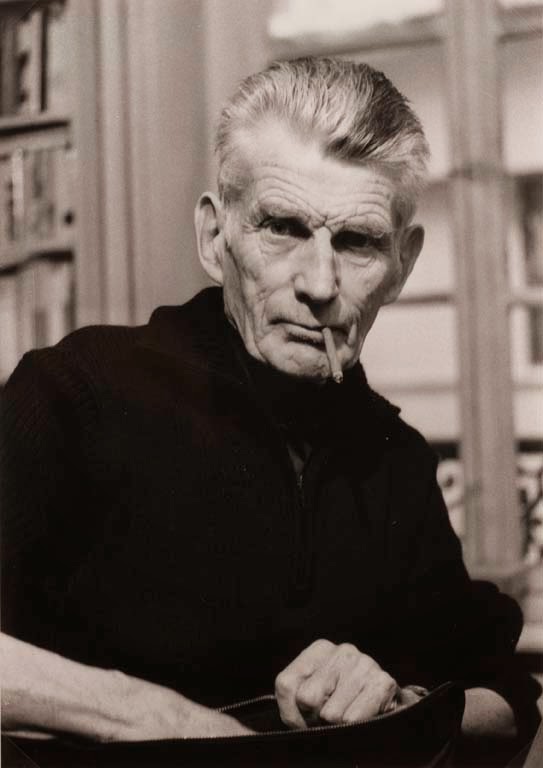
Cascando By Samuel Beckett
1
why not merely the despaired of occasion of wordshed
is it not better abort than be barren
the hours after you are gone are so leaden they will always start dragging too soon the grapples clawing blindly the bed of want bringing up the bones the old loves sockets filled once with eyes like yours all always is it better too soon than never the black want splashing their faces saying again nine days never floated the loved nor nine months nor nine lives
2
saying again if you do not teach me I shall not learn saying again there is a last even of last times last times of begging last times of loving of knowing not knowing pretending a last even of last times of saying if you do not love me I shall not be loved if I do not love you I shall not love
the churn of stale words in the heart again love love love thud of the old plunger pestling the unalterable whey of words
terrified again of not loving of loving and not you of being loved and not by you of knowing not knowing pretending pretending
I and all the others that will love you if they love you
3
unless they love you
— from Collected Poems in English and French, S. Beckett, Grove Press, Inc. N.Y. 1977. Source: msu.edu.
Samuel Barclay Beckett (13 April 1906 – 22 December 1989) was an Irish avant-garde novelist, playwright, theatre director, and poet, who lived in Paris for most of his adult life and wrote in both English and French. His work offers a bleak, tragicomic outlook on human nature, often coupled with black comedy and gallows humour.
Beckett is widely regarded as among the most influential writers of the 20th century. He is considered one of the last modernists. He is one of the key writers in what Martin Esslin called the “Theatre of the Absurd“.
Beckett was awarded the 1969 Nobel Prize in Literature “for his writing, which—in new forms for the novel and drama—in the destitution of modern man acquires its elevation”.
Arts & CultureComments Off on Theatre Review: Chekhov Collective’s The Seagull
Last week, I had the pleasure of attending the opening night of Chekhov Collective‘s The Seagull. The play is set in the Russian countryside during the 19th century. It depicts the romantic and artistic conflicts between four main characters; the famous middlebrow story writer Boris Trigorin (Patrick Garrow), the ingenue Nina (Nicole Wilson), the fading actress Irina Arkadina(Rena Polley), and her son the symbolist playwright Konstantin Tréplev (Riley Gilchrist). A beautiful summer night begins a tangle of emotional intrigues, unrequited love, dreams, family quarrels, and the steady thrum of time passing.
Sitting through the play, I found myself thinking of these various themes and also some questions. Throughout it, I began to wonder “What makes something a ‘rea’ piece of art? Is an abstract piece not ‘real’ because it doesn’t always follow a method or guidelines? And why do we often struggle to view another’s point of view?” Needless to say, The Seagull brings up plenty to think about during it, and afterwards.
Rena Polley and Riley Gilchrist Photo: Victoria Carr
As a ‘collective’, the cast certainly captures the essence of the Chekhov Technique — that of creating an inner event and use that to convey the emotions that tie themselves to the context played out. This is evident in the way the many relationships play out on-stage. It also plays out in how each individual character interacts with the others, and with us, the audience.
Konstantine “thinks in images.” He rejects the standard notion of writing and theatre for his time. He essentially questions the status quo and this upsets his mother, Arkadina, an established theatre actress. This disconnect plays a major toll in this relationship. But Konstantine and Arkadina are only not the only ones struggling in this story. Everyone seems to have underlying issues they are trying to deal, or perhaps not deal, with.
Two male characters, I personally liked Pjotr Nikolayevich Sorin (Greg Ellwand) and Dr. Dorn (Sean Sullivan). They are both funny, and quite observant. They understand others’ personalities and behaviours, more than most. As far as the women, they all excel. But it was Masha (Llyandra Jones), whose depressive personality and dark humour, stood out the most for me. What I enjoyed most was how the collective interacted with one another. They were believable as each of their characters. This is most likely due to their immersive approach, in preparing for this show.
Sean Sullivan and Greg Ellwand Photo: Victoria Carr
From a technical point, The Seagull has a very strong group of designers. The set, sound, and lighting designs echo the various moods of the play. Costumes by Joyce Gunhouse and Judy Cornish of Canadian label Comrags are also outstanding. But perhaps too perfectly so, especially because at times I found myself distracted by a lovely dress or suit, instead of paying more attention to the acting. Nonetheless, this is not a negative for the show whatsoever.
As a whole, The Seagull flows well, through upbeat moments well into its darker undertones. It begins with some comedic parts. It then proceeds with a sense of tension, almost suffocating, all the way to the end. It is not an easy play to sit through, if one is looking for a lighter type of show. But if one appreciates layers of emotional complexity, The Seagull does not disappoint. Chekhov’s words make one question how ideals can influence people’s lives and their behaviour. It clearly depicts how oftentimes dreams are just that, dreams… A sense of loss. And everyone of us can relate to this sense of loss; of times past. A definite recommendation.
Arts & CultureComments Off on Poetry Corner: Louise Bogan – Leave-Taking
Leave-Taking By Louise Bogan
I do not know where either of us can turn Just at first, waking from the sleep of each other. I do not know how we can bear The river struck by the gold plummet of the moon, Or many trees shaken together in the darkness. We shall wish not to be alone And that love were not dispersed and set free— Though you defeat me, And I be heavy upon you.
But like earth heaped over the heart Is love grown perfect. Like a shell over the beat of life Is love perfect to the last. So let it be the same Whether we turn to the dark or to the kiss of another; Let us know this for leavetaking, That I may not be heavy upon you, That you may blind me no more.
Louise Bogan (August 11, 1897 – February 4, 1970) was an American poet. She was appointed the fourth Poet Laureate to the Library of Congress in 1945.
Her syle was partially influenced by writers such as Rilke and Henry James, and partially by the English metaphysical poets such as George Herbert, John Donne, and Henry Vaughan.
As poetry editor of The New Yorker magazine for nearly 40 years, Bogan played a major role in shaping mainstream poetic sensibilities of the mid-20th Century.
Arts & CultureComments Off on Let’s Share A Few Laughs At The 9th Annual Toronto Sketch Comedy Festival
The 9th Annual Toronto Sketch Comedy Festival returns March 6-16. The festival highlights the best live, scripted comedy in North America. This year is no exemption with a diverse lineup of comedy troupes from around Canada, and abroad.
For those who are not familiar with sketch comedy, in general, it is basically a funny performance that is written, rehearsed and performed by a cast of comedians. If you’ve seen Saturday Night Live, or SCTV, or Kids in the Hall, then you’re familiar with it already. It is different from stand-up or improv. But it’s just as funny!
The 10-day festival offers an array of shows and performances. To make things a little simpler for you, I’ve chosen 5 events that would appeal to some of you.
From its description alone, this is going to make my inner nerd laugh. It will contain “weird science, awkward silence, comic book references and alternate endings to Battlestar Galactica.” You’ve been warned.
If you’re a fan of The Kids in the Hall, this is a not-to-be-missed night. All five members will grace the stage for a live reading of their 1996 cult film, Brain Candy. Musical accompaniment will be performed by the movie’s original film score composer Craig Northey (The Odds), and his all star band featuring Chris Murphy and Gregory MacDonald (Sloan). This is a one-night-only engagement.
Come see 12 of Toronto’s best sketch comedy performers present radio sketches for a chance to win $500 in cold, hard cash, plus a live-album recorded by SiriusXM.
Some of the troupes in the lineup include Tony Ho, Parker and Seville, Rocket Scientists, and more! The winner will be determined by the audience this same night.
From neurotic humour to dumb enough to being funny to hearing as many jokes as you can in one minute, three troupes in one night seems… well, definitely do-able.
As part of the festival’s workshops & panels series, this is a chance to meet sketch artists from other cities, and find out how the live sketch scene works for them. Featuring some of Sketchfest’s out of town performers.
The Lounge Series is open to performers and the public, and admission is FREE.
These are but a few highlights at this year’s festival. Hoping these get you out of the cold, enjoy a few laughs, and try something new.
THE 9TH ANNUAL TORONTO SKETCH COMEDY FESTIVAL
Thursday, March 6 – Sunday, March 16, 2014
The LOT (Lower Ossington Theatre), 100A Ossington Avenue
Arts & CultureComments Off on Art: ‘Galileo’s Falling Bodies’ at The Red Head Gallery
For those looking for a more intimate way of experience art, I would suggest visiting The Red Head Gallery. Located in a restored factory building located at 401 Richmond Street in downtown Toronto, the space offers us a nice escape from the mundane among art galleries, music galleries, publishers, shops, and a café. It’s one of my favourite places to visit impromptu in the city.
Next week, the gallery presents Galileo’s Falling Bodies by Nina Leo, in collaboration with Lee Henderson. Galileo’s Falling Bodies is a series of works that allegorically contemplate various states of discord through the movement, upset, and stasis of a teacup… Various moments of upheaval and recovery are captured and re-presented, collectively proposing an underlying beauty in surrender.
Nina Leo is a Canadian multi-disciplinary artist working primarily in drawing, installation, performance and public practice. Her work examines how the contemporary terrain of fragmented, often virtual experience may affect us phenomenologically as experiences and interactions become ever more accessible, yet divested of direct multi-sensorial richness. Leo holds an MFA in Emerging Practices from the University of Buffalo, SUNY. She is also an exhibiting member of the Red Head Gallery.
Lee Henderson is a media-based artist from Saskatchewan. He has studied art in Canada and Germany, with talented professionals including Maria Vedder, Brian Eno, and Ellen Bromberg. Since completing his MFA in 2005, he has been furthering his time- and lens- based artistic practice while teaching photography and media art at the postsecondary level (currently at OCADU and Ryerson University). Recent and upcoming exhibitions and screenings include the Zero Film Festival (Los Angeles), The Dunlop Art Gallery (Regina), The Rooms (St. John’s), Trinity Square Video, gallerywest, Artscape Youngplace, and YYZ (Toronto).
Always looking for something new or different to do and learn from, Galileo’s Falling Bodies sounds like an intriguing and perhaps challenging way to experience new art. I, for one, think it a good exercise for the mind and soul.
Nina Leo / Lee Henderson Galileo’s Falling Bodies, 2013 Pigment print on fibre, 29 x 43 in.
Arts & CultureComments Off on Sláinte! The Toronto Irish Film Festival Begins Tonight
The ultimate Irish pub crawl, a boxing legend at the height of his career, a madcap chase for missing millions, an Irish bird who’s afraid of flying and personal reconciliation are among the themes at this year’s Toronto Irish Film Festival (TIRFF). Starting tonight, Friday, February 28 to Sunday, March 2 at TIFF Bell Lightbox, TIRFF 2014 promises a weekend of cinematic good times with North American and Canadian Premieres, a classic Irish pub-night and some special guests from Ireland.
OPENING NIGHT GALA – THE IRISH PUB Director: Alex Fegan in attendance/Q & A following screening Friday, February 28, 2014, 7:00pm
This feature documentary is a eulogy to the greatest institution in Irish society, and the legendary Irish publicans who run them. An ode to the traditional Irish pub in all its glory: solid wood, stone floors, no music, little TV, knick-knacks and yellowed ceilings, Fegan’s camera slips from pub to pub meeting interesting and quirky publicans and patrons each step along the way.
OPENING NIGHT PARTY: Dora Keogh’s, 141 Danforth Avenue, 9:30pm Present your TIRFF ticket stub from ‘The Irish Pub’ to meet director Alex Fegan enjoy the celebration!
TIRFF 2014 IRISH SHORTS PROGRAM Saturday, March 1, 2014, 5:00pm Canadian Premiere
Fear of Flying- director Conor Finnegan This is an animated short about a small bird with a fear of flying trying to avoid heading south for the winter.
The End of the Counter – director Laura McGann This short recalls the moment in 1965 when grocery shopping in Ireland changed forever with the birth of the supermarket.
Two Wheels Good – director Barry Gene Murphy This short follows four seasoned veterans of the Irish open road celebrating a lifetime in the saddle.
The Tree – director David Freyne Set in post-Apocalyptic Ireland, two strangers meet in a silent fight for survival.
Breakfast Wine – director Ian Fitzgibbon This is a dark comeday, wehre two alcoholics have their daily routine disrupted by a beautiful stranger.
This is the story of how, in July 1972 an historic boxing match in Croke Park between Muhammad Ali and Alvin ‘Blue’ Lewis brought the nation to a standstill. Ross Whitaker’s film, produced during the 40th anniversary of the fight, combines a wealth of archival material with colourful reminiscences of people who came into contact with Ali during his time in Ireland.
MADE IN BELFAST Director: Paul Kennedy Saturday, March 1, 2014, 9:00pm
Shot in thirteen days on a micro budget, Made In Belfast, Paul Kennedy’s directorial debut proves that money is no substitute for a great story. Jack Kelly (Ciaran McMenamin) is a successful novelist who leads a reclusive life in his apartment in Paris. But when circumstances conspire to bring him back to his hometown for a few days, he resolves to put things right with the friends he betrayed, the brother he abandoned and the fiancée he jilted.
MOONE BOY – Season II Canadian Launch Creator & co-writer: Chris O’Dowd Sunday, March 2, 2014, 5:00pm
Back in 2012, Chris O’Dowd and Nick Vincent Murphy charmed Sky 1 and BITE TV (in Canada) audiences with their semi-autobiographical coming-of-age comedy set in the small Irish town of Boyle in 1989. Following the adventures of 12-year-old Martin Moone (David Rawle), the series celebrated family life as Martin set about growing up amid his chaotic clan, ably assisted by imaginary friend Sean Murphy (O’Dowd), who was always on hand with some not-so-wise words of advice.
LIFE’S A BREEZE Director: Lance Daly Sunday, March 2, 2014, 7:00pm
A feel good “recession comedy”, starring Fionnula Flanagan, Pat Shortt and Kelly Thornton. Inspired by a real life Israeli human interest story, the film follows three generations of a Dublin family struggling to stay afloat and stay together through hard times in Ireland. Chaos ensues when Nan reveals that she’d stashed her life savings of 1 million euros in her old mattress which the kids took to the dump. A madcap race to all of Dublin’s landfills follows and soon the family are joined by the whole country on their search to find Nan’s treasure.
With a varied lineup such as this, a weekend at the movies sounds just about right. You can find more information on TIRFF at torontoirishfilmfest.com. Oh… and don’t forget to drop by the pub for a pint!
Mi táctica es mirarte aprender como sos quererte como sos
mi táctica es hablarte y escucharte construir con palabras un puente indestructible
mi táctica es quedarme en tu recuerdo no sé cómo ni sé con qué pretexto pero quedarme en vos
mi táctica es ser franco y saber que sos franca y que no nos vendamos simulacros para que entre los dos no haya telón ni abismos
mi estrategia es en cambio más profunda y más simple
mi estrategia es que un día cualquiera no sé cómo ni sé con qué pretexto por fin me necesites.
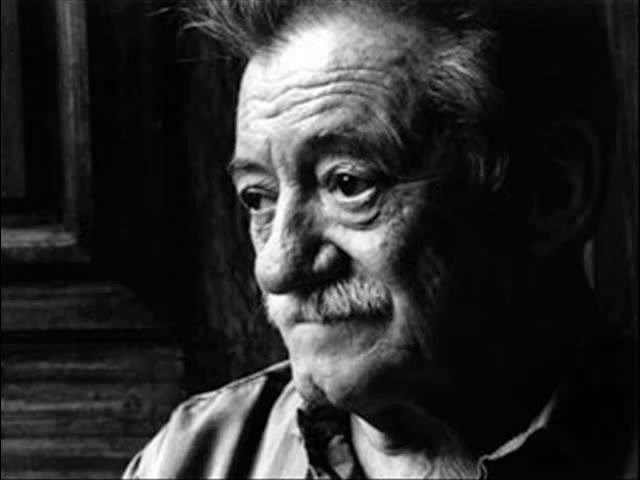
Mario Benedetti (4 September 1920 – 17 May 2009) was an Uruguayan journalist, novelist, and poet as well as being an integral member of the Generación del 45 — a group of writers, mainly from Uruguay, who had a notable influence in the literary and cultural life of their country and region. Their name derives from the fact that their careers started out mainly between 1945 and 1950.
Benedetti wrote of the human condition – love, the passage of time, death, misery, injustice, loneliness and hope – but in a simple, direct language. Many of his poems became songs, put to music by the Uruguayan writer and musician Daniel Viglietti and the Catalan singer/songwriter Joan Manuel Serrat.
In spite of publishing more than 80 books and being published in twenty languages he is not well known in the English-speaking world, but in the Spanish-speaking world he is considered one of Latin America’s most important writers from the latter half of the 20th-century.
Arts & CultureComments Off on Photography Exhibit: The Foot That Moves the Pedal By Henry VanderSpek
The Foot That Moves the Pedal… is a month-long celebration in images of the diverse ways bikes are used globally. The exhibit brings together some of Henry’s favourite images of bicycles from North America and East Africa.
I came to know Henry last summer and have had the chance to know more about him and his work since. I like the way he is able to capture people and some really personal moments through his photography. According to soulfunkspecial.com, images of people are one of the most desirable types of image for the internet in particular and it’s hard to argue with that. But overall, his photographic work is pretty diverse. This lends itself perfectly for this upcoming exhibit.
His fascination with bikes has been a theme in his photography for some time. He shares, “Ever since I was a child watching my father bike to work each day, bikes have had a hold on my imagination… I indeed love how bikes are often both functional and graceful objects of style, and even art.”
The space provided by the Toronto Public Library makes this a good way to learn more from Henry himself, but also take a closer look at his work. He is really excited to share several new, previously unshown, photos at this exhibit. The images on display were captured while travelling in Santa Monica, Los Angeles, Toronto, Montreal, Paris and Rwanda over the span of a few years.
If you’d like to meet Henry, hear more about his work and take in the exhibition, drop by Runnymede Library on one of the following times:
Saturday March 1st, 12:00 – 2:00 PM Thursday March 20th, 6:00 – 8:00 PM
You can also take a look at the gallery on the Culture Snap Photography website, as well for more information on Henry and his work.
The Foot That Moves the Pedal By Henry VanderSpek
Dates: March 1st – 31st (library is closed Sundays)