Miguel Angel Asturias Rosales (October 19, 1899 – June 9, 1974) was a Nobel Prize-winning Guatemalan poet, novelist, playwright, journalist and diplomat. Asturias helped establish Latin American literature’s contribution to mainstream Western culture, and at the same time drew attention to the importance of indigenous cultures, especially those of his native Guatemala.
Arts & CultureComments Off on The Toronto Film Critics Association Announces 2013 Awards
Inside Llewyn Davis, Joel and Ethan Coen’s tale of a folk singer making his way through Greenwich Village, 1961, won two top prizes at the 2013 awards of the Toronto Film Critics Association (TFCA).
Inside Llewyn Davis was named Best Picture, with Oscar Isaac winning the Best Actor prize.
The awards were voted by the TFCA at a meeting Dec. 15. The membership also chose the three finalists for the Rogers Best Canadian Film Award: The Dirties, directed by Matt Johnson, Gabrielle, directed by Louise Archambault; and Watermark, directed by Jennifer Baichwal and Edward Burtynsky.
The 2013 BMO Allan King Documentary Award is given to The Act of Killing; director Joshua Oppenheimer will receive a $5,000 cash prize.
The 2013 TFCA Awards will be presented at a gala dinner at Toronto’s Carlu on Tuesday, January 7, 2014, hosted by Cameron Bailey, Artistic Director of the Toronto International Film Festival. There the TFCA will also reveal the winner of the Rogers Best Canadian Film Award, which carries a record-setting $100,000 cash prize, the richest arts award in the country. The runners-up will each receive $5,000.
The TFCA named A Touch of Sin the year’s Best Foreign-Language Film. Jia Zhang-ke’s ambitious, stylized look at life in contemporary China stars Zhao Tao and Jiang Wu as ordinary citizens forced into violent confrontations by an apathetic and amoral state.
“It’s been an unusually thrilling year for cinema,” said TFCA President Brian D. Johnson, film critic at Maclean’s. “And these awards celebrate a remarkable diversity. Among our distinctive Canadian finalists, each offers an inspired take on a compelling issue—from school bullying in The Dirties to sexual liberation among the disabled in Gabrielle to epic environmental crisis in Watermark.”
Also the January 7 Gala, the TFCA will also announce the winner of the Manulife Financial Student Film Award, which carries a $5,000 cash prize. It will be presented to a short film that the critics select from student entries submitted by film programs at Humber College, Ryerson University, Sheridan College and York University.
Previously announced, the 2013 recipient of the Technicolor Clyde Gilmour Award is Norman Jewison who will present a filmmaker of his choice with $50,000 worth of services at Technicolor. The winner of the Scotiabank Jay Scott Prize for an emerging artist, Matt Johnson, will be presented with a $5,000 cheque for The Dirties, which he directed, starred in and co-wrote.
The full list of Toronto Film Critics Association Awards winners and runners-up:
BEST PICTURE “Inside Llewyn Davis” (Mongrel Media) Runners-up “Her” (Warner Bros.) “12 Years a Slave” (Fox Searchlight) BEST ACTOR Oscar Isaac, “Inside Llewyn Davis” Runners-up Chiwetel Ejiofor, “12 Years a Slave” Matthew McConaughey, “Dallas Buyers Club” BEST ACTRESS Cate Blanchett, “Blue Jasmine” Runners-up Julie Delpy, “Before Midnight” Greta Gerwig, “Frances Ha” BEST SUPPORTING ACTOR Jared Leto, “Dallas Buyers Club” Runners-up Michael Fassbender, “12 Years a Slave” James Franco, “Spring Breakers” BEST SUPPORTING ACTRESS Jennifer Lawrence, “American Hustle” Runners-up Lupita Nyong’o, “12 Years a Slave” June Squibb, “Nebraska” BEST DIRECTOR Alfonso Cuarón, “Gravity”
Runners-up Joel Coen & Ethan Coen, “Inside Llewyn Davis” Steve McQueen, “12 Years a Slave” BEST SCREENPLAY, ADAPTED OR ORIGINAL Spike Jonze, “Her” Runners-up Richard Linklater, Ethan Hawke & Julie Delpy, “Before Midnight” Joel Coen & Ethan Coen, “Inside Llewyn Davis”
BEST FIRST FEATURE “Neighboring Sounds”, directed by Kleber Mendonça Filho Runners-up “Fruitvale Station”, directed by Ryan Coogler “In a World …”, directed by Lake Bell BEST ANIMATED FEATURE “The Wind Rises” (Touchstone Pictures) Runners-up “The Croods” (20th Century Fox) “Frozen” (Walt Disney Pictures) BEST FOREIGN-LANGUAGE FILM “A Touch of Sin” (Films We Like) Runners-up “Blue Is the Warmest Color” (Mongrel Media) “The Hunt” (Mongrel Media) BMO ALLAN KING DOCUMENTARY AWARD “The Act of Killing” (Films We Like) Runners-up “Leviathan” (Films We Like) “Tim’s Vermeer” (Mongrel Media) ROGERS BEST CANADIAN FILM AWARD FINALISTS “The Dirties” (Phase 4 Films) “Gabrielle” (Entertainment One) “Watermark” (Mongrel Media)
There you have it, an interesting list of winners and runners-up. Some bold choices in my opinion like Best Documentary Act of Killing, and a surprising non-win for The Hunt in the Best Foreign Film category.
I have some catching up to do when it comes to watching some of the other films on this list. Curious what other film aficionados have to say about this list of winners. Leave a comment and share with the rest of us. And see you at the movies!
Arts & CultureComments Off on Poetry Corner: E.E. Cummings – somewhere i have never travelled,gladly beyond
somewhere i have never travelled,gladly beyond by E. E. Cummings
somewhere I have never traveled,gladly beyond any experience, your eyes have their silence: in your most frail gesture are things which enclose me, or which I cannot touch because they are too near
your slightest look easily will unclose me though I have closed myself as fingers, you open always petal by petal myself as Spring opens (touching skillfully, mysteriously)her first rose
or if your wish be to close me, I and my life will shut very beautifully ,suddenly, as when the heart of this flower imagines the snow carefully everywhere descending;
nothing which we are to perceive in this world equals the power of your intense fragility:whose texture compels me with the color of its countries, rendering death and forever with each breathing
(I do not know what it is about you that closes and opens; only something in me understands the voice of your eyes is deeper than all roses) nobody, not even the rain, has such small hands
E. E. Cummings, Edward Estlin Cummings (October 14, 1894 – September 3, 1962) was born in Cambridge, Massachusetts. He began writing poems as early as 1904. In his work, Cummings experimented radically with form, punctuation, spelling and syntax, abandoning traditional techniques and structures to create a new, highly idiosyncratic means of poetic expression. His body of work encompasses approximately 2,900 poems, two autobiographical novels, four plays and several essays, as well as numerous drawings and paintings.
Arts & CultureComments Off on Photography — Ghost Dance: Activism. Resistance. Art.
Only a few weeks remain to see Ghost Dance: Activism. Resistance. Art.currently on view at the Ryerson Image Centre (RIC) until December 15, 2013. Guest curated by Steve Loft, the newly appointed Coordinator of Aboriginal Arts at the Canada Council for the Arts, this exhibition examines activism as a culture of resistance in contemporary indigenous art. This exhibition presents photographs from the Black Star Collection with contemporary works by aboriginal artists to examine the role of the artist as activist, as chronicler and as provocateur in the ongoing struggle for indigenous rights and self-empowerment.
Ghost Dance: Activism. Resistance. Art. features the work of prominent indigenous artists, including Sonny Assu, Vernon Ah Kee, Dana Claxton, and Skawennati. In describing the exhibition, Loft writes, “Colonialism has been the cause of the suffering, oppression and violence perpetuated against Indigenous people in Canada and many other countries, for centuries… As a curator and art historian I would posit that Aboriginal art is innately political. It is the culmination of lived experiences, from pre-contact customary societies through the colonial enterprise. It is tied up in histories that include both pre- and post-contact epistemologies, narratives empowered by continuity, inextricably inter-linked; and it is the assertion of cultural autonomy and sovereignty.”
This Wednesday, December 11 at 6pm, you can hear more from Steve Loft and a special guest, for a guided walk-through of the exhibition.
You can also join in the conversation online on the exhibition blog at imagearts.ryerson.ca/ghostdance, by contributing knowledge or memories of the individuals and places captured in the 99 Black Star photographs, which are displayed on the Salah J. Bachir New Media Wall during off-gallery hours. The blog provides an online forum for you to contribute knowledge or memories of the individuals and places captured in the 99 photographs from the Black Star Collection.
Whether you make it to the exhibition or not, I recommend going online to read more about it, learn about the history of Canada’s First Nations, and how their art is a means to chronicle the “struggle for Indigenous rights and self-empowerment”.
Michael Abramson, “Untitled” (American Indian Movement: Lakota Indians), Wounded Knee, South Dakota, USA, 1973, gelatin silver print. Reproduction from the Black Star Collection at Ryerson University. Courtesy of the Ryerson Image Centre. BS.2005.285357 / 187-546
Force, no matter how concealed, begets resistance. (Lakota saying)
In which she describes rationally the irrational effects of love Sor Juana Inés de la Cruz
That my heart is suffering from love pangs is plain, but less clear by far is the cause of its pain.
To make fancy come true my heart strains but, thwarting desire, only gloom remains.
And when most I plead and lament my plight, though I see my sadness, its cause escapes sight.
I yearn from the chance to which I aspire, yet when it impends, I shrink from desire, lest, sensing at hand that longed-for day, my misgivings spoil it, fear drive it away.
And if, reassured, I clasp it tight, with the slightest pretext, all pleasure takes flight.
My timid misgivings turn boon into bane and for love’s very sake, I must show disdain. *(Translated by Alan S. Trueblood)
En que escribe racionalmente los efectos irracionales del amor
Este amoroso tormento que en mi corazón se ve, se que lo siento y no se la causa porque lo siento
Siento una grave agonía por lograr un devaneo, que empieza como deseo y para en melancolía.
y cuando con mas terneza mi infeliz estado lloro se que estoy triste e ignoro la causa de mi tristeza.
Siento un anhelo tirano por la ocasión a que aspiro, y cuando cerca la miro yo misma aparto la mano. Porque si acaso se ofrece, después de tanto desvelo la desazona el recelo o el susto la desvanece.
Y si alguna vez sin susto consigo tal posesión cualquiera leve ocasión me malogra todo el gusto.
Siento mal del mismo bien con receloso temor y me obliga el mismo amor tal vez a mostrar desdén.
Source: Wikipedia
Sor Juana Inés de la Cruz was a self-taught scholar and poet of the Baroque school, and Hieronymite nun of New Spain. Although she lived in a colonial era when Mexico was part of the Spanish Empire, she is considered today both a Mexican writer and a contributor to the Spanish Golden Age, and she stands at the beginning of the history of Mexican literature in the Spanish language.
Arts & CultureComments Off on Poetry Corner: Robert Frost – Birches
Birches By Robert Frost
When I see birches bend to left and right Across the lines of straighter darker trees, I like to think some boy’s been swinging them. But swinging doesn’t bend them down to stay. Ice-storms do that. Often you must have seen them Loaded with ice a sunny winter morning After a rain. They click upon themselves As the breeze rises, and turn many-colored As the stir cracks and crazes their enamel. Soon the sun’s warmth makes them shed crystal shells Shattering and avalanching on the snow-crust– Such heaps of broken glass to sweep away You’d think the inner dome of heaven had fallen. They are dragged to the withered bracken by the load, And they seem not to break; though once they are bowed So low for long, they never right themselves: You may see their trunks arching in the woods Years afterwards, trailing their leaves on the ground Like girls on hands and knees that throw their hair Before them over their heads to dry in the sun.
But I was going to say when Truth broke in With all her matter-of-fact about the ice-storm (Now am I free to be poetical?) I should prefer to have some boy bend them As he went out and in to fetch the cows– Some boy too far from town to learn baseball, Whose only play was what he found himself, Summer or winter, and could play alone.
One by one he subdued his father’s trees By riding them down over and over again Until he took the stiffness out of them, And not one but hung limp, not one was left For him to conquer. He learned all there was To learn about not launching out too soon And so not carrying the tree away Clear to the ground. He always kept his poise To the top branches, climbing carefully With the same pains you use to fill a cup Up to the brim, and even above the brim. Then he flung outward, feet first, with a swish, Kicking his way down through the air to the ground. So was I once myself a swinger of birches. And so I dream of going back to be. It’s when I’m weary of considerations, And life is too much like a pathless wood Where your face burns and tickles with the cobwebs Broken across it, and one eye is weeping From a twig’s having lashed across it open.
I’d like to get away from earth awhile And then come back to it and begin over. May no fate willfully misunderstand me And half grant what I wish and snatch me away Not to return. Earth’s the right place for love: I don’t know where it’s likely to go better. I’d like to go by climbing a birch tree, And climb black branches up a snow-white trunk Toward heaven, till the tree could bear no more, But dipped its top and set me down again. That would be good both going and coming back. One could do worse than be a swinger of birches.
Robert Frost circa 1910 Photo: Wikipedia
Robert Lee Frost (March 26, 1874 – January 29, 1963) was an American poet. His work was initially published in England before it was published in America. He is highly regarded for his realistic depictions of rural life and his command of American colloquial speech.Frost was honored frequently during his lifetime, receiving four Pulitzer Prizes for Poetry. He was also awarded the Congressional Gold Medal in 1960 for his poetical works.
Arts & CultureComments Off on 2013 Blood in the Snow Canadian Film Festival: Colour Me Gory
Now in its second year, the Blood in the Snow Canadian Film Festival (BITS) continues with its mandate “to highlight the best in contemporary horror film making in Canada”.
As someone who’s come to horror and genre films more recently, this is my first year taking a peek at BITS and what it has to offer. Bear this in mind when perusing down my list of suggested films below.
Friday, Nov. 29th – 7pm EVANGELINE (dir. Karen Lam) Screening with short film To Hell, With Love (dir. Gavin Michael Booth) Evangeline is a revenge fantasy about a young woman who is brutally killed by a group of sociopathic college frat boys, and comes back from the dead to seek vengeance.
Saturday, Nov. 30th – 4pm THE GHOSTKEEPERS (dir. Anthony Mann) Screening with short film A Certain Kind of Monster (dir. Mike Moring) The cast of a horror movie reunites to celebrate their success and get more than they bargained for in Marlowe House. Can they survive a horrifying night of Ghosts, Demonic Possessions, Murder and Revenge?
Saturday, Nov. 30th – 9:30pm CLEAN BREAK (dir. Tricia Lee) Screening with short film One More For The Road (dir. Navin Ramaswaran) A psycho girlfriend, Tracy, moves in with her boyfriend Scott and his two roommates, Cam and Dan, only to start targeting them when they get in the way of her plans for the perfect relationship.
Sunday, Dec. 1st – 7pm DISCOPATH (dir. Renaud Gauthier) Screening with short film Lively (dir. Jay Clarke) The mid-70’s: a timid young New Yorker leads an uneventful life until he is fatefully exposed to the pulsating rhythms of a brand-new genre of music: disco. Unable to control his murderous impulses that stem from a traumatic childhood experience, Duane Lewis transforms into a dangerous serial killer exiled to Montreal.
If you do not mind seeing blood, gore, and are interested in seeing what independent horror filmmakers are creating, BITS is the place to be this weekend.
The 2013 Blood in the Snow Canadian Film Festival will be screening in full gory at the Carlton Cinema from November 29 – Dec 1st. For more details about box office, full listings and schedule, visit bloodinthesnow.ca.
Arts & CultureComments Off on Film Spotlight: William Kurelek’s The Maze
The Maze by William Kurelek Photo: The Maze Movie
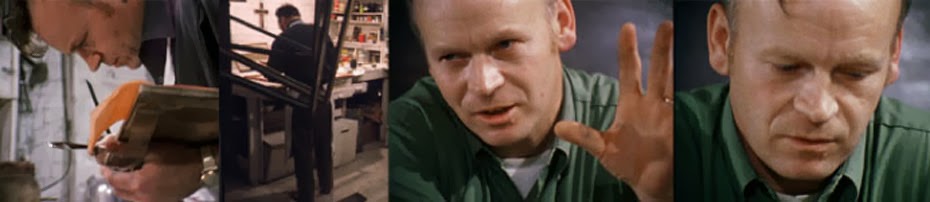
William Kurelek’s The Maze is a feature length film about the life and art of renowned Canadian artist, William Kurelek. The documentary explores his struggles with attempted suicide and a self-professed spiritual crisis. It is dramatically told through his paintings and his on-camera revelations.
The creation of this film started over 40 years ago and has been passed down through generations. Filmmaker Robert Young created a thirty-minute version in 1969, though enough footage was available for a feature version. Brothers Nick and Zack Young restored and reimagined their father’s 1969 film with the help of modern technology to provide the current version of Kurelek’s story.
I first learned about the film and Kurelek’s work at the Rendezvous With Madness Film Festival last year. Before it screened at the festival, however, William Kurelek’s The Maze was part of the 25th anniversary celebration of Workman Arts in October 2012. At the festival, the film was really well received to a sold out audience. It certainly impressed me in terms of Kurelek’s work but also his personal story, and how he had been affected by mental illness as well.
Back in 1969, Kurelek described The Maze as “…a painting of the inside of my skull, which I painted when I was in England as a patient in Maudsley and Netherne psychiatric hospitals. It is a story of my life, well in the sense that people tell stories by the fireplace to entertain their guests, trying to make them accept you. In this case I wanted to be accepted, as an interesting specimen.” How poignant a statement!
William Kurelek Photo: The Maze Movie
Now, Nick and Zack Young launched their Kickstarter with the goal of raising $50,0000 to complete and release both William Kurelek’s The Maze and the bonus film Out of the Maze. They have surpassed this $50K goal, and are hoping to achieve a new goal of $55 000 by Monday Nov 25th. The fact they’ve received so much support already is an indication of how important the film, Kurelek’s story & his work are, not only as projects that focus on art but also to the ongping dialogue about mental health. If you’d like to be part of helping Nick and Zack achieve this new goal while at the same time helping create this project, you can donate until midnight/12 a.m. EST, next Monday. To do so, visit themazemovie.com where you can help these young filmmakers complete this multi-generational project.
Their hope is to make the film available worldwide in different languages including French, Ukrainian and Spanish, finish animations and master a proper surround sound mix. The bonus film Out of the Maze will include rare interviews of Kurelek’s art dealer Avrom Isaacs, Kurelek’s art assistants, close family and friends, historians, art therapists and psychologist. The film will also feature many additional paintings, as William Kurelek painted over 3,000 paintings in his lifetime.
As with any Kickstarter campaign, there are a number of exciting rewards up for grabs including William Kurelek’s The Maze on DVD, a rare limited edition archival Kurelek print of I am Proud of my Humility, and a special Director’s Edition package that unlocks some hidden relics from the original making of the film in 1969, packaged inside a reproduced vintage film canister.
The Maze is still housed in London at the Bethlem Royal Museum and Archives. This winter, the filmmakers will bring the film full circle to Maudsley hospital for its UK premiere in February 2014. You can bee part of the final chapter and help finish this 40-year long endeavour. Take a peek at the trailer below, then visit themazemovie.com. There are certain projects that are worth our investing efforts; this is one, in my opinion.
Arts & CultureComments Off on Poetry Corner: T.S. Eliot – The Love Song of J. Alfred Prufrock
The Love-Song of J. Alfred Prufrock By T.S. Eliot
S’io credesse che mia risposta fosse A persona che mai tornasse al mondo, Questa fiamma staria senza piu scosse. Ma perciocche giammai di questo fondo Non torno vivo alcun, s’i’odo il vero, Senza tema d’infamia ti rispondo.
Let us go then, you and I, When the evening is spread out against the sky Like a patient etherized upon a table; Let us go, through certain half-deserted streets, The muttering retreats Of restless nights in one-night cheap hotels And sawdust restaurants with oyster-shells: Streets that follow like a tedious argument Of insidious intent To lead you to an overwhelming question. . . Oh, do not ask, “What is it?” Let us go and make our visit.
In the room the women come and go Talking of Michelangelo.
The yellow fog that rubs its back upon the window-panes The yellow smoke that rubs its muzzle on the window-panes Licked its tongue into the corners of the evening Lingered upon the pools that stand in drains, Let fall upon its back the soot that falls from chimneys, Slipped by the terrace, made a sudden leap, And seeing that it was a soft October night Curled once about the house, and fell asleep.
And indeed there will be time For the yellow smoke that slides along the street, Rubbing its back upon the window-panes; There will be time, there will be time To prepare a face to meet the faces that you meet; There will be time to murder and create, And time for all the works and days of hands That lift and drop a question on your plate; Time for you and time for me, And time yet for a hundred indecisions And for a hundred visions and revisions Before the taking of a toast and tea.
In the room the women come and go Talking of Michelangelo. And indeed there will be time To wonder, “Do I dare?” and, “Do I dare?” Time to turn back and descend the stair, With a bald spot in the middle of my hair— [They will say: “How his hair is growing thin!”] My morning coat, my collar mounting firmly to the chin, My necktie rich and modest, but asserted by a simple pin— [They will say: “But how his arms and legs are thin!”] Do I dare Disturb the universe? In a minute there is time For decisions and revisions which a minute will reverse.
For I have known them all already, known them all; Have known the evenings, mornings, afternoons, I have measured out my life with coffee spoons; I know the voices dying with a dying fall Beneath the music from a farther room. So how should I presume?
And I have known the eyes already, known them all— The eyes that fix you in a formulated phrase, And when I am formulated, sprawling on a pin, When I am pinned and wriggling on the wall, Then how should I begin To spit out all the butt-ends of my days and ways? And how should I presume?
And I have known the arms already, known them all— Arms that are braceleted and white and bare [But in the lamplight, downed with light brown hair!] Is it perfume from a dress That makes me so digress? Arms that lie along a table, or wrap about a shawl. And should I then presume? And how should I begin?
. . . . .
Shall I say, I have gone at dusk through narrow streets And watched the smoke that rises from the pipes Of lonely men in shirt-sleeves, leaning out of windows? . . . I should have been a pair of ragged claws Scuttling across the floors of silent seas.
. . . . .
And the afternoon, the evening, sleeps so peacefully! Smoothed by long fingers, Asleep . . . tired . . . or it malingers, Stretched on the floor, here beside you and me. Should I, after tea and cakes and ices, Have the strength to force the moment to its crisis? But though I have wept and fasted, wept and prayed, Though I have seen my head (grown slightly bald) brought in upon a platter, I am no prophet–and here’s no great matter; I have seen the moment of my greatness flicker, And I have seen the eternal Footman hold my coat, and snicker, And in short, I was afraid.
And would it have been worth it, after all, After the cups, the marmalade, the tea, Among the porcelain, among some talk of you and me, Would it have been worth while, To have bitten off the matter with a smile, To have squeezed the universe into a ball To roll it toward some overwhelming question, To say: “I am Lazarus, come from the dead, Come back to tell you all, I shall tell you all” If one, settling a pillow by her head, Should say, “That is not what I meant at all. That is not it, at all.” And would it have been worth it, after all, Would it have been worth while, After the sunsets and the dooryards and the sprinkled streets, After the novels, after the teacups, after the skirts that trail along the floor— And this, and so much more?— It is impossible to say just what I mean! But as if a magic lantern threw the nerves in patterns on a screen: Would it have been worth while If one, settling a pillow or throwing off a shawl, And turning toward the window, should say: “That is not it at all, That is not what I meant, at all.”
. . . . .
No! I am not Prince Hamlet, nor was meant to be; Am an attendant lord, one that will do To swell a progress, start a scene or two Advise the prince; no doubt, an easy tool, Deferential, glad to be of use, Politic, cautious, and meticulous; Full of high sentence, but a bit obtuse; At times, indeed, almost ridiculous— Almost, at times, the Fool.
I grow old . . . I grow old . . . I shall wear the bottoms of my trousers rolled.
Shall I part my hair behind? Do I dare to eat a peach? I shall wear white flannel trousers, and walk upon the beach. I have heard the mermaids singing, each to each.
I do not think they will sing to me.
I have seen them riding seaward on the waves Combing the white hair of the waves blown back When the wind blows the water white and black.
We have lingered in the chambers of the sea By sea-girls wreathed with seaweed red and brown Till human voices wake us, and we drown.
Source: tminima.org
Thomas Stearns Eliot (26 September 1888 – 4 January 1965) was an essayist, publisher, playwright, literary and social critic and “one of the twentieth century’s major poets.” He was awarded the Nobel Prize in Literature in 1948, “for his outstanding, pioneer contribution to present-day poetry”. (Wikipedia)