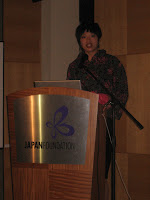
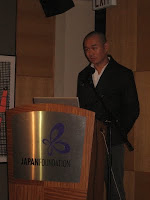
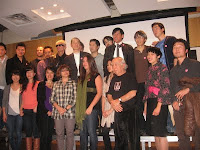
This fundaiser event was brought to my attention by my aunt Ruth… Please read on and share with those who may be interested. We may not live in Guatemala anymore but we can still help those who do.
If you live in the Toronto area, feel free to drop in and find out more.
The translation is not the greatest but its point is succinct. To read more about this crisis, I recommend this story from the Guatemala-Times Website.
Muchas gracias, HM
NO MORE POST-PARTUM
DEATHS IN COBAN-GUATEMALA.
Fundraising
Many women dies in Guatemala after delivery, because of poverty.
The Lanquin proyect
and
Fundación Semillas de Esperanza
November saturday 14th, at 6 p.m.
CUPE 4400 1482 Bathrust St. / St. Clair Ave. West
Suite 200
Audivisual information about “Corridor of Death”
Delicious Guatemalan food, music, Maya’s crafts and raffles.
Come and HELP US TO HELP THEM!!
Free entry.
More information: Maria, 416 537 31 47
They call it “Corridor of Death”
Claudia Palma
It is a strip of serpentine roads that crosses Carchá, Campur, Lanquín, Cahabón and that in the last months has extended to Chahal, Chisec and Senahú, Verapaz Discharge. They call the “Corridor of Death” due to the statistics in health of the zone: of each one thousand live births, 266 mothers do not see their children grow or they die during the childbirth or by later complications. The national average was 153 maternal deaths for each one thousand live births, according to the report Basal Line of Maternal Mortality of 2000. The World-wide Organization of the Health (WHO) statistic was 148 maternal deaths for each one thousand live births in 2005. Numbers for a country where on average a boy is born every minute, and the worst statistics of mortality are surpassed only by Haiti (670 for each one thousand live births).
At Campur, one of the 16 villages of Carchá, Verapaz Discharge, is arrived by a way from terracería that borders challenging precipices. A small truck is prepared to undertake the adventure to descend by the mountain. In its broken-down wood body it transports to half hundred of villagers, the majority are young. One week ago one of these vehicles upset and made colapsar the Position of Health of Campur. The result: 7 wounded, 2 was transferred in the ambulance, other 2 in a patrol of Policía Nacional Civil (PNC) and rest 3 were taken care of in center of Permanent Attention of 24 Hours. There the doctors examine to the patients with oxidized lamps of ganso, count on a nebulizador that dates from 20 years ago, the manual ventilator (for artificial respiration) does not serve, although there is no oxygen either. Tens of mothers left their life in that delivery room. “We cannot do much”, says Eduardo Thomae, the director of the center. In his voice there is an indignation mixture, it excuses and fear and…, yes, fear to that the desperate population by makes them to uncertainty suffer the same fate that to other settler years back when they were lynched. The six CAP of Verapaz Discharge were created during this Government to improve the conditions of health in rural areas difficult like Campur, but they are not obtaining it. The worse statistics live. Thus they work now, but they fear that it makes worse with the cut of the 25 percent (Q1,495 million less) to budget 2009 of the Ministry of Health of Q3 thousand 372,7 million, due to the crisis. Although governmental agreement 132-2009 of austerity, assures that it will not touch the social cost.
With less than the basic things
In Governing with the People celebrated in Verapaz Discharge the 18 of September of 2007 remembered reinforce these centers of 24 hours, but in Campur if a baby has fetal suffering or inhales meconio is no form to help it. Not even there are nasogástricas soundings used to feed the premature babies. In the warehouse of the small pharmacy only there were three vitamin blisters K indicated to avoid the hemorrhages. Thomae, by its account, takes statistics equal of worrisome. After the incursion of My Family It progresses in the village, 400 women of 600 who participated did not go by the Depo Provera -the injection to prevent pregnancies – with the belief that when procreating more babies its remittance would increase. Nobody explained to them that they could not become pregnant in a smaller period of three years, although specifies one of the clauses of the program At the covers of vaccination in Campur never it is arrived because the statistics of the health center never agree with those of the National Institute of Estadística (INE). That organization reports 80 thousand 570 inhabitants and the position of health 56 thousands 520 and by that incongruity of 30 thousand inhabitants is that the predicted goals are not reached.
Deputy Nineth Montenegro, of Encounter by Guatemala, controls for a year to the NSI. “The organization received an extra budget that it has as destiny the formulation of censuses for My Family Progresses, separating that the original objective of its creation and it is politicized”. Test of which it says, is the information hung in the site in Internet of the Government 11 Monday the first lady, Sandra de Colom, traveled to Verapaz Discharge, to the places where it ordered the “recensos” to include to those who have still not been benefitted by the program.
While in Campur, it is not possible to be requested tastes for the thread of sutures, of a single thickness and nothing else. The doctors wash the hands with rationed water, only outline a sarcastic giggle when asking to them for the surgical soap. But it is a CAP, and as so the women taken care of there count themselves between the 41 percent of which they pay attention to them in a maternity. In the neighboring country of El Salvador it is the 85 percent. Clearly, its population is smaller, the topography is almost flat, own better access roads and a single language.
Guatemala is a country without statistical culture. A report of the Project by the Promotion of the Rights of the Informal Work (TO POUND, by its abbreviations in English), complementary program of the Cafta, it emphasizes that for 30 years it has been lacked use statistics. In its report it concludes that it does not exist a systematization of the data nor regularity to collect them and there is no a coordination between public institutions either. “This will have a strong one and inevitable cost in the formulation, implementation and evaluation of public policies”, they notice elPeriódico tried to contact to Martian Castle, director of the NSI, but never it took care of the calls.
They are born and they die, how many?
For two years the country it has been lacking updated vital statistics: “To most of the children they register a year after being born, when there are Elogrado’ as they say here. If they die before never exist in papers “, it comments Carlos Kick, to help of infirmary in Campur, while it reviews the medicine inventory. No longer there is not multivitamins for children nor salbutamol for the asthmatic ones, equipment intravenous caterización to apply serum either.
There is no certainty from how many they are born or they die in this zone. The absence of these numbers does not allow trustworthy projections in cover in health and education, explains Myrna Montenegro and Myrna Ponce of the Observatory of Reproductive Health. In spite of the little reliability of the registries, Nancy Azurdia, ordered of the Center of Health of Carchá ventured itself to make a calculation of 420 orphaned children who have left 84 mothers who died during or after the childbirth in the last 8 years in that municipality. It if esteem that each mother has an average of 5 children. But, “we do not have an exact form to know it”, is sorry. The Law of Social Development in its Article 117 says that the NSI must collect and publish the vital statistics during the first ten days of November of every year. The function is in charge of the National Registry of People (Renap), that not yet coordinates with all the municipalities nor hospitals.
110 kilometers to survive
In the middle of a humid heat, in the other end of the map of Verapaz Discharge, in Cahabón, the nurses ingenian them to make sheets with pieces that they buy in the paca. He is more of just like in Campur.
“Of position of attention of 24 hours we only have the name”, says director Byron Montoya who has not received payment for 4 months like many doctors engaged by Health in that zone. He is gynecologist, paediatrician and traumatólogo in the CAP of the place.
They are the bad ways, the topography, the barriers of the language and the slow system when identifying cases of high risk the causes of maternal mortality. Although three deaths in the last registered the word of the healer of the community influenced in the refusal to transfer to the patients to a hospital. Or the same relatives are against since it happened a year ago with Candlemas Tiu Caal. It died in the small room of emergencias of the Position of Health, uterine atony and vaginal hemorrhage was the causes of their death. When the family allowed to transfer it, died, was 16 years old. His unique son who survived is to the care of his grandmother of 35 years. In the country each, 8 minutes an adolescent is mother, says Romeo Menéndez, that represents Latin America in the World-wide Committee of Safe Maternity.
The pregnancies of smaller women of 19 years represent the 20 percent of the total of daily births that annually add near 400 thousand childbirths in the country, adds. The Central American Institute of Fiscal Studies (Icefi) documents a study on the right to the health and the education altogether with the Center for the Economic and Social Rights with you soothe in Spain and New York that will present/display in June. The rough draft narrates the case of a woman in Senahú that traveled between the 27 and the 28 of December of 2007 more than 18 hours in a truck by ways of terracería. It was to 110 kilometers to survive after the long-haul between its community, the hospital of the Red and finally the regional one of Cobán at which never it arrived. The statistics in maternal mortality, say Menéndez, are so poor that to only they place us in front of Haiti, but the statistics after all lie.
Copyright © 2009 Aldea Global, S. A. Todos los Derechos Reservados