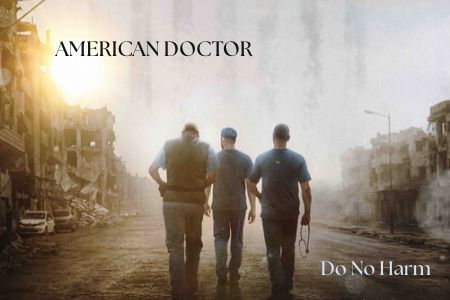
American Doctor offers a committed look at the intersection of medical ethics and state-sponsored violence. The documentary follows three physicians from the USA; Dr. Mark Perlmutter, Dr. Thaer Ahmad, and Dr. Feroze Sidhwa as they navigate the dual frontlines of providing emergency care in Gaza and advocating for their patients in the United States. Directed by Poh Si Teng, the film serves as a record of genocide and a testament to the need to bear witness as part of a global community.
Setting the Scene
American Doctor premiered in the U.S. Documentary Competition at the 2026 Sundance Film Festival before winning the Audience Award at the Hot Docs Canadian International Documentary Festival. It is now expanding theatrically across Canada and the USA.
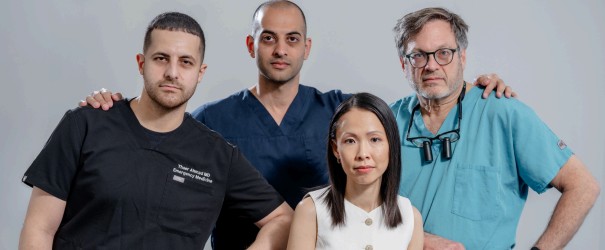
Teng’s feature debut follows three doctors bound by the Hippocratic oath but divided by background: Dr. Perlmutter, a Jewish American orthopedic surgeon; Dr. Feroze Sidhwa, a trauma surgeon raised by Zoroastrian-Parsi parents; and Dr. Thaer Ahmad, a Palestinian American emergency physician. Their work in Nasser Hospital in Khan Younis shows us the drive to save lives transcends religion, creed and nationality.
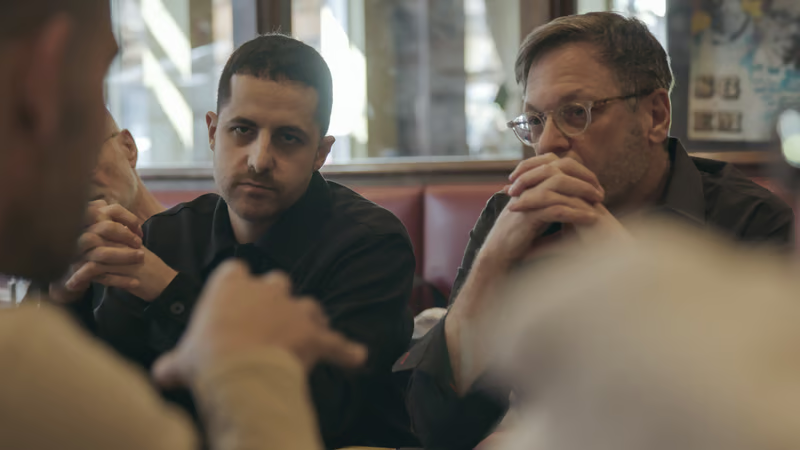
The film also shows the barriers the doctors encounter. Dr. Ahmad is repeatedly denied entry into Gaza due to his Palestinian heritage. While his colleagues operate under literal fire, he fights the battle from Jordan and later in the halls of Congress. This serves to highlight how identity can be weaponized to exclude even those who want to provide healthcare and humanitarian aid.
The opening scene establishes the film’s moral and ethical position. Teng sits with Dr. Perlmutter over photos of mutilated children, suggesting she might pixelate the images to preserve their dignity. Perlmutter’s response is direct: “Israel took away their dignity… you have the responsibility to tell the truth.” From here on, the camera asks us, the audience, to see the destruction and devastation inflicted on civilians and healthcare infrastructure alike.
Bearing Witness to Genocide
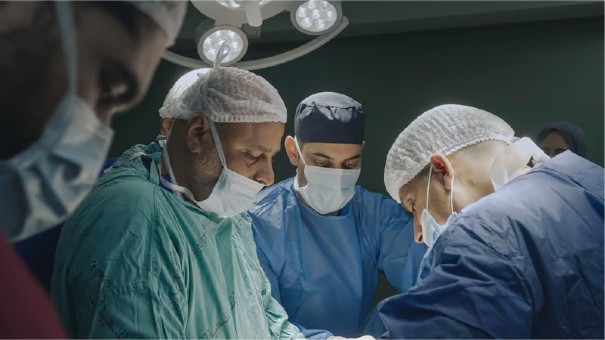
Teng’s direction feels steady given the uncertainty of the situations and conditions recorded. Directors of Photography Ibrahim Al Otla and Chris Renteria are steadfast with their cameras while bombs fall counterpointing the surgeons’ precise work. The film shows moments of calm and during medical triage, which are quite methodical in the midst of the horror of the environment; further asking us to sit with the unease of seeing the doctors practice medicine with the threat of bombs landing nearby. The film focuses on the healthcare workers, showing how gutted their facilities are and how little support they receive from the international community.
Interview with Director Poh Si Teng & Doctors
Poh Si Teng is a Malaysian-American journalist and filmmaker whose previous work includes producing the Academy Award-nominated short St. Louis Superman. She left her role at ABC News Studios to direct American Doctor, funding much of the initial production herself. During my conversation with Teng, Dr. Thaer Ahmad and Dr. Feroze Sidhwa, they shared about the personal toll of carrying such heavy truths.
They also feel hopeful and reflected on the value and strength of having such a diverse group both in front of and behind the camera. They emphasized this richness in perspective is both a narrative device and a reflection of how everyday life should mirror solidarity across differences. The collaborative process itself became a testament to the unity the film advocates for.
On Burnout and Boundaries
With the film now releasing internationally, the team is embarking on press tours and activism. When asked about protecting their mental health, their responses revealed the deep complexities of survivorship and duty.
Dr. Thaer Ahmad spoke about the specific burden of being part of the Palestinian diaspora. He described a persistent sense of survivor’s guilt, noting that everyday actions like ordering food from an app remind him of privilege in direct contrast with the starvation and death in Gaza. For him, the boundary between rest and action is thin; he remains very aware of whether the broader community is showing up in support, feeling the weight of collective visibility.
Dr. Feroze Sidhwa offered a perspective rooted in humility. He shared a story of a surgeon in Gaza who continued operating while his fiancé’s father lay dead in a nearby room. That surgeon later prayed for the man and visited his grave. Sidhwa used this anecdote to imply that what he has experienced pales in comparison to what his colleagues and friends endure daily in Palestine. This awareness acts as both a motivator and a grounding mechanism, reminding him (and us) of the scale of suffering beyond his (our) own experience.
For Director Poh Si Teng, the question of burnout was initially one she resisted answering. However, she opened up about the important role of the community sustaining her. She recounted how a Jewish American therapist offered her support during the making of the film, and how her circle in New York extended their hands, literally and figuratively, to hold her up. For Teng, the act of making this film was supported by a network of care that mirrored the solidarity shown on screen.
On Professional Repercussions and Systemic Silence
Beyond the emotional toll, our conversation also touched on the institutional silence surrounding the genocide. When asked about professional repercussions, Dr. Ahmad noted that while he has not faced overt penalties, he hopes younger people will continue entering the field of medicine and seek positions of leadership. In his opinion, for real change to occur, current leaders must step down to allow new voices to assume roles where they can enact changes in policy.
Dr. Sidhwa pointed to an obvious hypocrisy within the medical establishment. He observed that while various U.S. medical associations quickly condemned the treatment of healthcare workers in Ukraine, there has been nothing close to that level of condemnation for the systematic targeting of medical staff in Palestine. This divide, he suggested, reflects a broader moral inconsistency in how Western institutions prioritize certain conflicts over others.
On the Power of Storytelling
Reflecting on the journey from the film’s premiere at the Sundance Film Festival to wide release, the group shared how the reception of the film has shifted. Initially, Dr. Ahmad and Dr. Sidhwa were not sure if audiences would care, but the response has grown significantly. Teng noted that attending a more mainstream festival after Sundance served as a “real test,” revealing that many U.S. citizens were previously unaware of the brutal reality in Palestine. Over time, public awareness has increased, with more people voicing concerns and supporting the cause.
When asked what they wish people knew, Teng emphasized the importance of staying engaged and informed. She expressed hope that audiences realize that no matter how hopeless things feel, there is power in speaking out against injustice.
Hye’s Final Thoughts
I appreciate the integrity behind American Doctor. I also appreciate its cinéma vérité approach, which shows the intimate, high-stakes reality of medical care in a conflict zone without sensationalizing it. The film manages to balance the very visceral horror of the footage with the solemn dignity of the doctors doing their jobs.
What is important to understand is how the film shows advocacy not as a political act, but as a continuation of the medical oath. By taking their testimony to Congress and the media, the doctors are aiming to treat the systemic failure that allows genocide to continue. The diversity of the crew and cast strengthens this message, showing that solidarity across whichever line, religious or ethnic, is not just possible but critically essential in current times.
American Doctor is a very difficult watch, as it should be. It demands that we look with full attention. In a landscape where stories from Gaza are often obscured or minimized, this film stands as a powerful reminder that witnessing and not turning away, scrolling or looking away, is a form of resistance and commitment to a better world.
The film is making its way through the U.S. and Canada, with further expansion planned through the fall.
Images courtesy of Watermelon Pictures and Game Theory Films.